
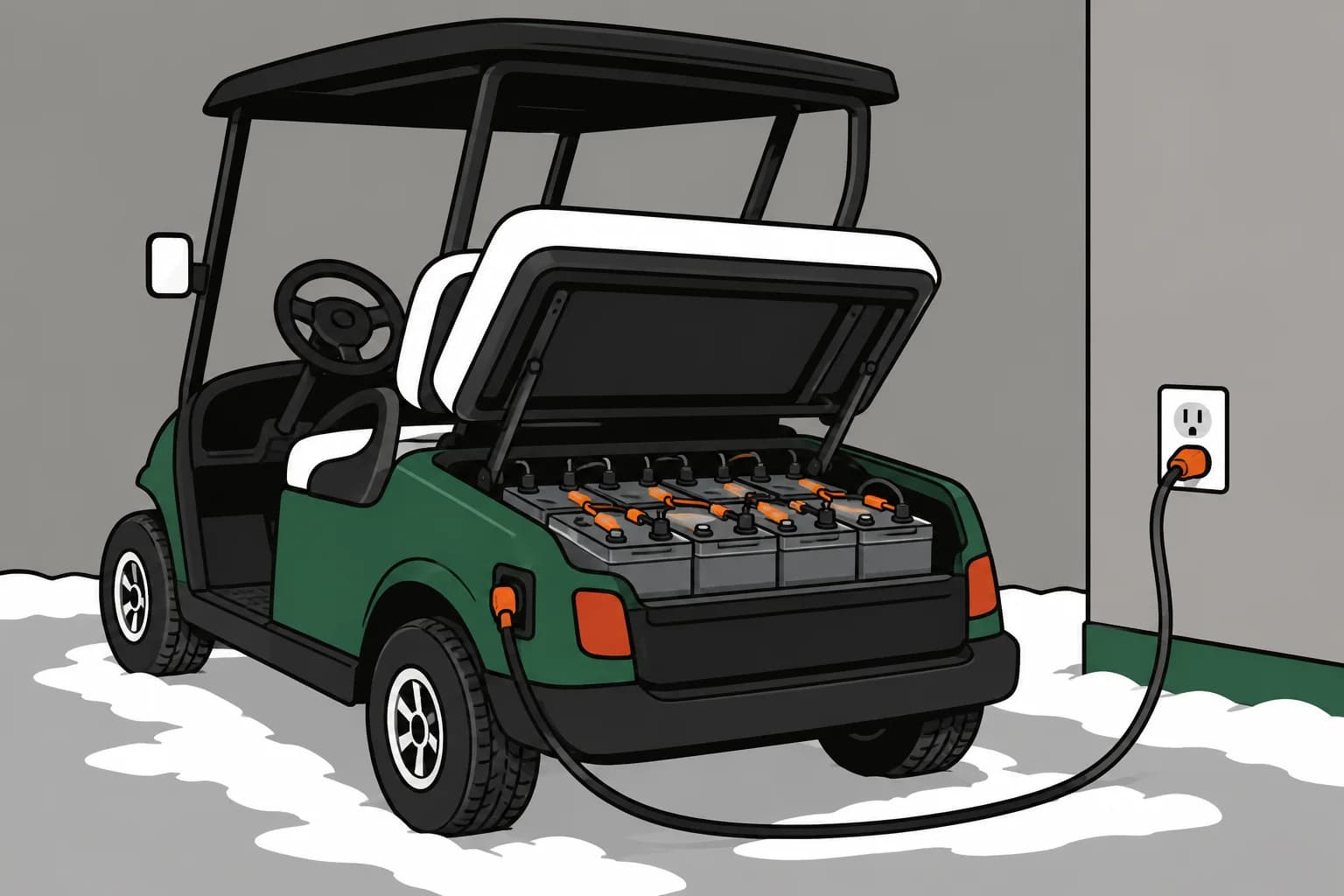
Montana winters are hard on an electric cart, and almost all of the damage happens to the battery pack while the cart sits doing nothing.
Do this in October. The valley usually gets its first frost sometime in September, and the nights that are actually cold enough to hurt a pack come later, so October is the window where the work is still comfortable and you are still ahead of it.
Allow about an hour. If you would rather not, seasonal packages exist for exactly this reason.
1. Charge it fully first
Everything else follows from this, and the numbers are worth knowing because they are not close.
A fully charged lead acid pack does not freeze until roughly 92 below. The coldest it has ever been in Kalispell is 38 below, in January of 1950. A charged pack has never been in danger here and never will be.
Let that same pack sit at around 40 percent and it freezes at about 16 degrees. Kalispell's average January low is a shade under 15.
That is the whole guide in two sentences. A charged pack cannot freeze in a Flathead winter. A half flat one freezes on an ordinary January night, not a record breaking one, and when the water in it freezes it expands, cracks plates and sometimes splits the case. None of that comes back in the spring.
Put it on the charger and let it complete a full cycle before you do anything else.
2. Water the cells, after charging
Check every cell. After charging, the electrolyte should sit about an eighth of an inch below the bottom of the fill well. The top of the plates is the minimum, not the target.
Use distilled water only, and do it after the charge, never before. Electrolyte expands while charging, and a cell topped off beforehand will boil acid out over the tops.
Lithium owners skip this step entirely, which is one of the quieter arguments for converting.
3. Clean the terminals
Baking soda and water neutralizes the corrosion. Scrub the terminals and cable ends, rinse carefully without letting any solution get into the cells, dry it, then put a light coat of terminal protectant on.
Check every cable is tight while you are there. A loose connection makes heat, and heat kills batteries.
4. Decide where the pack spends the winter
Two options that both work:
Leave it in the cart, charged, and reset the charger once a month. Modern chargers stop when full and will not restart on their own, so the pack slowly self discharges over the winter. A monthly reset keeps it topped up. This is the option most people choose and the one they most often forget to actually do.
Or pull the pack and store it somewhere above freezing on a maintainer.
What you must not do is leave it in an unheated shed at partial charge until April. That is the exact combination the 16 degree number above is describing, and an unheated shed in the Flathead spends a good part of January below it.
5. Put it in tow mode
If Jared is doing your winterization this is already handled, and it is worth knowing he does it: every electric cart he services goes into TOW mode for the winter and has to be switched back to RUN in the spring before it will drive.
If you are doing it yourself, the same logic applies. Tow mode disconnects the drive circuit so nothing is being quietly drawn down while the cart sits.
6. Tires
Air them to spec. A cart sitting all winter on soft tires flat spots and the sidewalls suffer.
7. Mice
The most underrated winter problem around here. They nest in seats, chew wiring and get into everything.
Steel wool packed into any opening, dryer sheets under the seat, and a couple of traps nearby. All of it is cheap compared to rewiring a harness in the spring.
8. Clean it and park it properly
Wash the grass and dirt off, especially underneath. Wet organic matter sitting against metal all winter is how frames start to go.
Park it out of the weather if you can, on a hard surface rather than dirt. If it has to be outside, cover it but leave airflow. A tarp wrapped tight to the ground traps moisture and does more harm than no cover.
What good looks like in spring
If you did this, the cart should charge normally, hold voltage under load, and drive like it did in October. If it does not, the pack likely took damage before the winter rather than during it.
Call Jared on 406.270.9346 and he will load test it and tell you where you stand.