
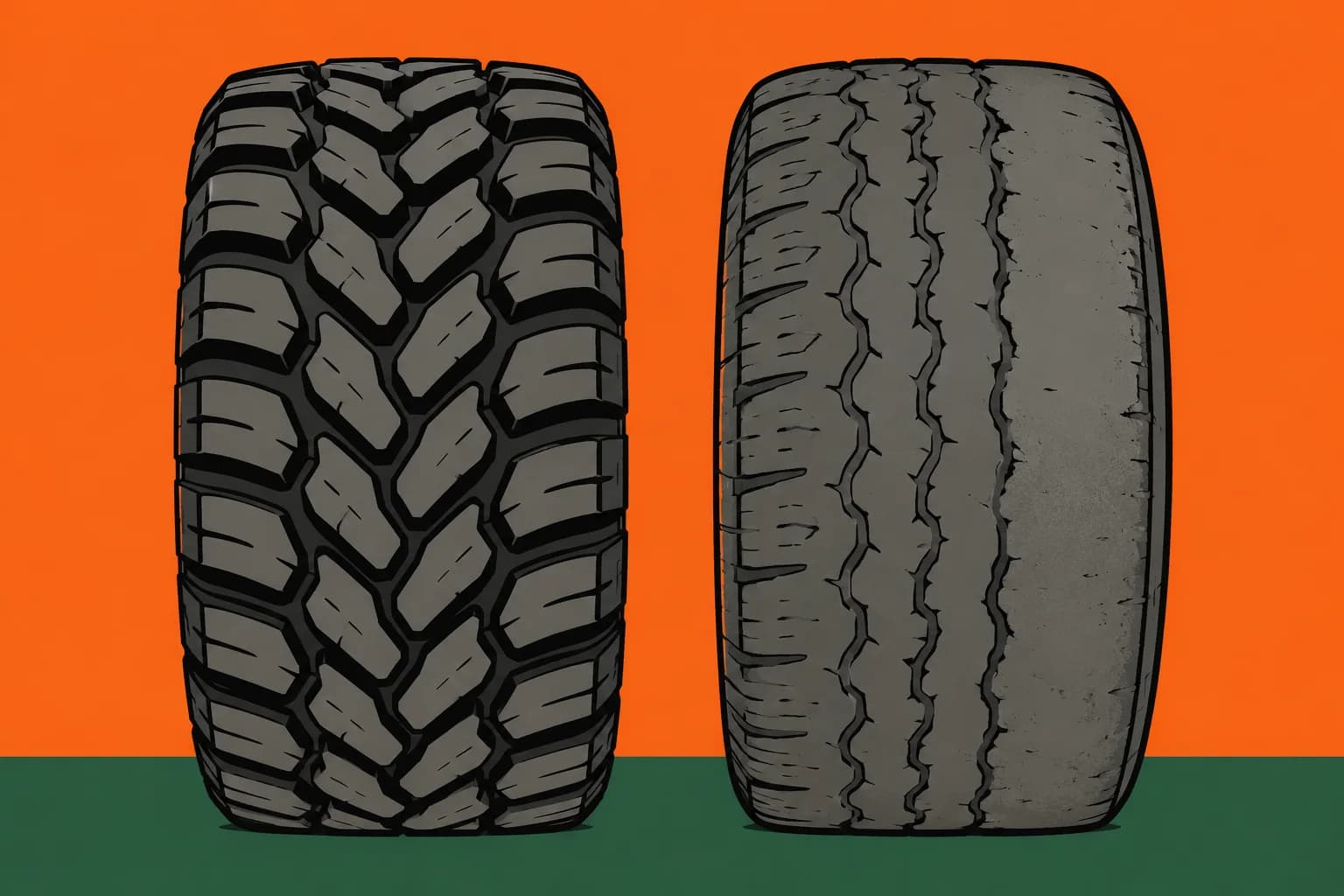
Tires are one of the few things on a cart you can judge yourself with your eyes and your hands. Here is what to look for, and more importantly what the wear pattern is telling you.
The obvious ones
Cracks in the sidewall. Golf cart tires often die of age rather than mileage. A cart that does two hundred miles a year can still have tires that are ten years old and full of fine cracks. Once the rubber is checked like that, replace them. It does not get better.
Tread worn smooth. If you can no longer feel the blocks with your hand, you have no grip on wet grass or gravel.
Flat spots. From sitting all winter on soft tires. Sometimes they work out after a few warm days of use, sometimes they do not.
The wear patterns worth reading
This is where you can save money, because the pattern tells you what to fix.
Worn down the middle, good on the edges. Over inflated. You have been running too much pressure and the tire has been riding on its centre. Check what pressure your cart actually calls for, and remember heat raises pressure, so a tire set in April can be over by August.
Worn on both edges, good in the middle. Under inflated. The tire has been rolling onto its shoulders.
Worn on one edge only. Alignment or a bent component. This is the one that matters. If you replace the tire without fixing the cause, the new one wears out the same way. On a lifted cart this often traces back to a lift kit that went on without the front end being set up properly afterward.
Cupped or scalloped wear. Usually worn bushings or a dead shock letting the wheel bounce.
Pressure, briefly
Most golf cart tires want far less pressure than a car tire. Check the sidewall and the cart's own spec, and do not just fill them to the number on a compressor. Over inflating is the single most common tire mistake I see, and it makes the ride harsh as well as wearing the centres out.
Do not buy tires without checking the wheel
If you are replacing tires and thinking about going bigger, the wheel diameter has to match and the overall height has to clear your lift. There is a calculator on the site that works both of those out, and it will also tell you what a taller tire does to your top speed.
The short version: a 22 inch tire needs about a 4 inch lift, and a 23 needs about a 6. Buying tires that do not fit is an expensive afternoon.
When it is worth calling
If the wear is uneven, get the cause looked at before you buy rubber. Ten minutes with the cart on stands will tell me whether it is bushings, alignment or a lift that never got finished properly.
406.270.9346.